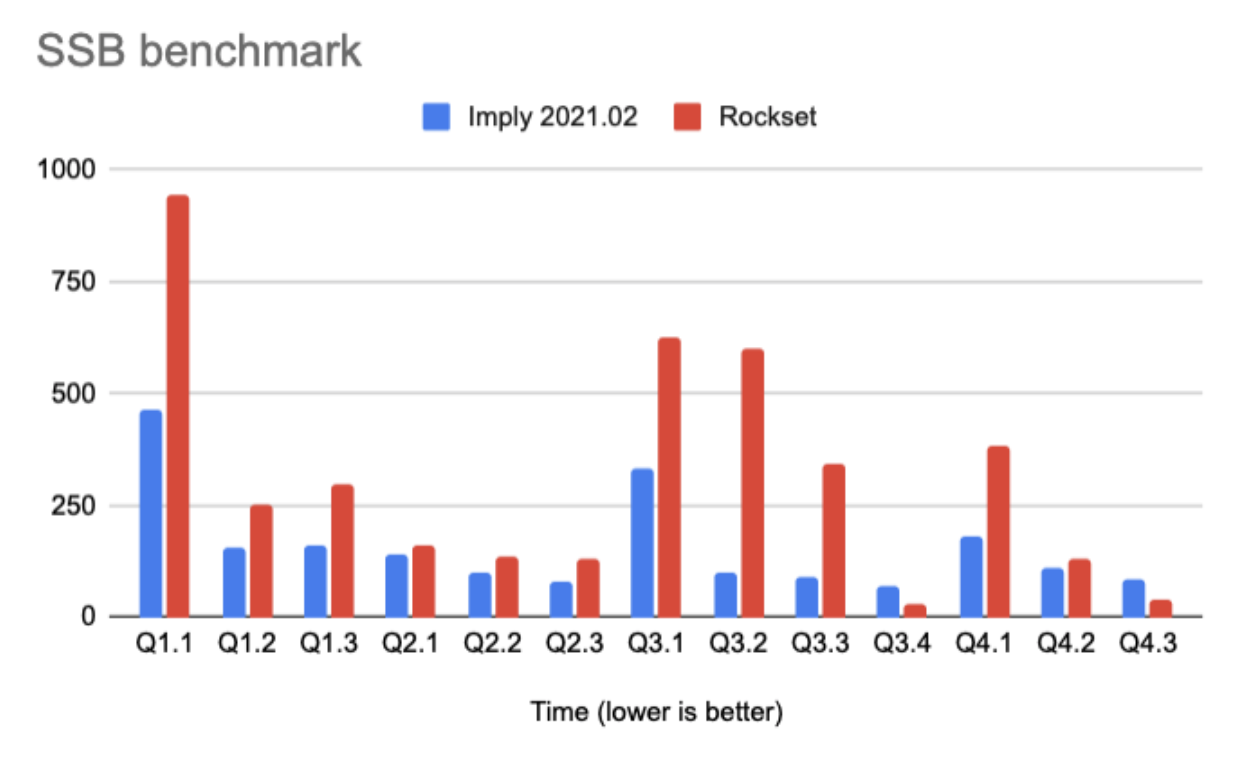
Rockset recently published a blog post that compared the performance of Apache Druid 0.18 versus Rockset using the SSB benchmark. Druid 0.18 is about 9 months out of date at this point, so we wanted to revisit the benchmark based on the latest version of Druid (0.20.1), which includes several performance improvements we’ve been doing over the last few months.
Our findings are below:
Query
Imply3.3.0
Imply 2021.02
Rockset
Q1.1
1245
462
944
Q1.2
155
154
254
Q1.3
92
160
296
Q2.1
662
139
161
Q2.2
591
102
136
Q2.3
319
79
129
Q3.1
292
333
626
Q3.2
514
102
598
Q3.3
417
91
343
Q3.4
100
72
32
Q4.1
883
179
384
Q4.2
389
109
132
Q4.3
384
87
41
6043
2069
4076
We can see a remarkable improvement in performance with the latest version of Druid. Two main things drove most of the change:
1) Many of these queries in the SSB benchmark use expressions. In older versions of Druid, we did not have vectorized expressions implemented, so many of the queries couldn’t vectorize. In the latest version, 100% of these queries vectorize.
2) The schema used to ingest data was changed to match what Rockset is doing. Similar to how Rockset “specified some keys for column-based clustering”, we also used column based clustering (in Druid it’s called partitioning). No further tuning was done in Druid.
In our next release of Druid, we are releasing another set of performance improvements. Stay tuned for more information.
Other blogs you might find interesting
No records found...
Oct 14, 2026
Search your Splunk DDSS archive without restoring it
Security teams often keep logs long after they have aged out of their SIEM platform’s searchable window. The data is there for investigations or audits, but accessing the data for insights can be complicated....
Claude makes dashboards now, Lumi is ready for them
This week Anthropic launched Claude Dashboards in beta. You connect a data source, ask a question in plain language, and Claude writes the queries and builds the dashboard. For Imply Lumi customers, this...
Lumi Lounge Recap: 3 Takeaways from Splunk .conf26
The Imply Lumi Lounge sat directly across the street from Splunk .conf26 and reached venue capacity on both days. Digital signs around the Colorado Convention Center pointed attendees our way with a simple...
 Alan Li