This week Anthropic launched Claude Dashboards in beta. You connect a data source, ask a question in plain language, and Claude writes the queries and builds the dashboard.
For Imply Lumi customers, this works on day one. Lumi already exposes a SQL MCP server, so Claude can query that data and turn the results into a dashboard.
Let’s have a glance at the finished product first:

See it in action
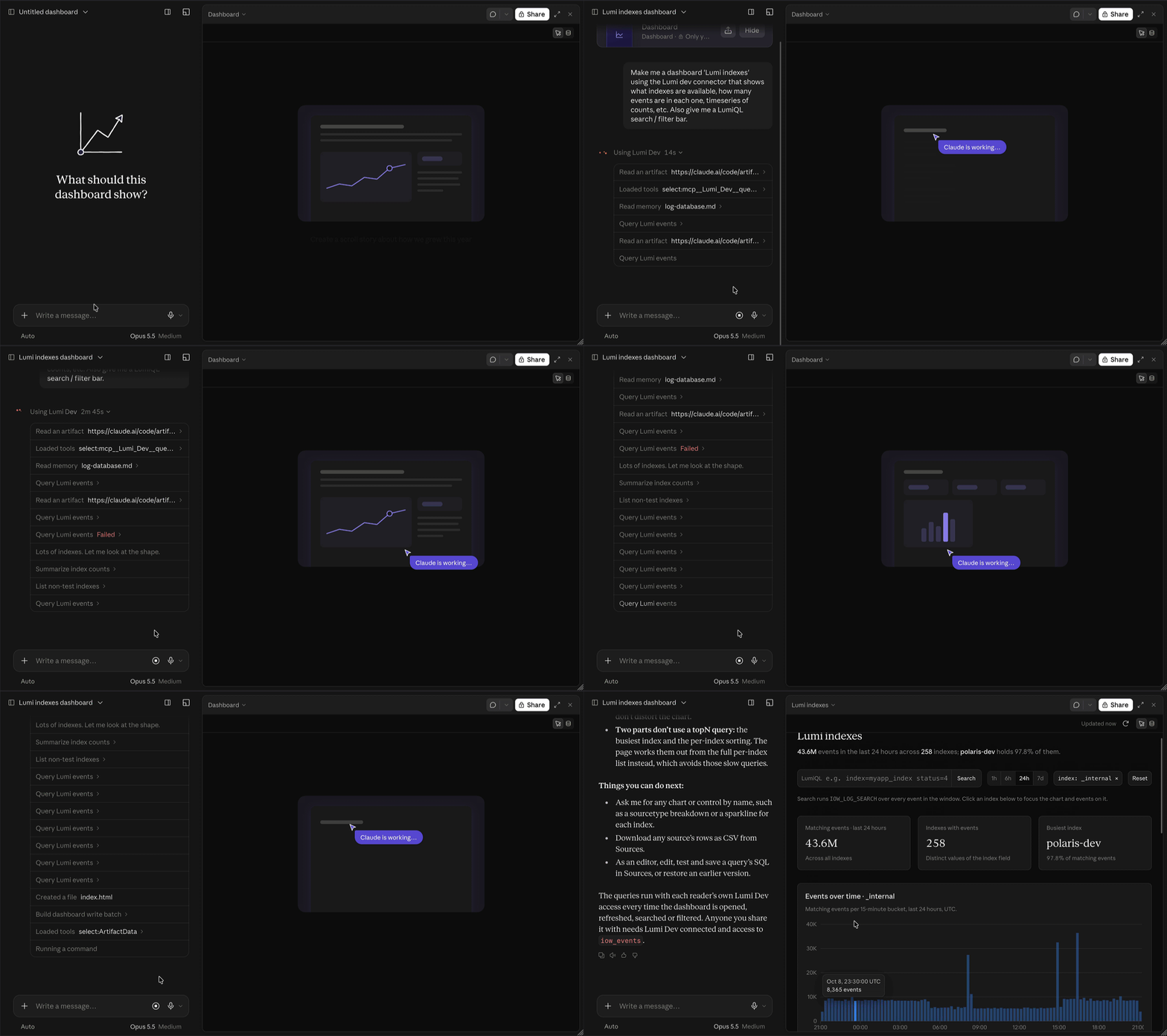
In the GIF above, Claude is connected to Lumi through the SQL MCP integration. We ask it to “Make me a dashboard using the Lumi dev connector that shows what indexes are available, how many events are in each one, time series of counts, etc. Also give me a LumiQL search / filter bar.”
Claude explores the schema, writes SQL queries, runs them against Lumi, and assembles the dashboard. We describe what we want to see, and Claude handles the queries and charts.
Why it just works: one data layer, many languages
Lumi supports both SPL and SQL natively. The security data analysts search using SPL through Splunk federated search is also available through SQL to tools like Claude.
That means teams can keep their existing Splunk searches, dashboards, and detections while using Claude to explore the same underlying data. They don’t need a separate copy just to support a new interface.
This is the practical value of separating security data from the tools that analyze it. When a new tool comes along, teams have another way to use the data they already retain.
The agentic SOC starts with the data layer
At Splunk .conf26, Imply co-founder and CTO Gian Merlino made the case that the hard part of an agentic SOC is not the agent. Agents don’t query like scheduled detections do. They follow the evidence: one suspicious login turns into questions about the user, the device, the IP and similar activity across months of history. Gian showed an experimental AI SOC that an Imply engineer built in a single day using Claude Code. The harness was the easy part. What made it useful was the data underneath it.
Claude Dashboards is the same lesson applied to the human side of the SOC. Building the dashboard is now the easy part: Claude does it in minutes. What decides whether the dashboard is worth looking at is whether the data layer can answer fast, cheaply and over enough history to matter.
We think this points to something bigger. The SOC interface of the next few years may not live in a SIEM console, or even in Imply’s own UI. It may live in Claude: investigate in a conversation, pin what matters to a dashboard, share it with the team, and hand the next question to an agent. Every one of those steps runs on the same thing: a data layer that speaks the agent’s language.
Your next SOC might just be Claude
If you already run Lumi, you can try this today: connect Claude to Lumi’s SQL MCP server, turn on Dashboards (on Enterprise plans an org owner enables it under Organization settings), and ask your first question.
If you don’t run Lumi yet, the path is short. Keep Splunk, use Lumi underneath it to make more data searchable at lower cost, and point Claude at the same data.
Request a Lumi demo to see how Splunk and Claude can work with the same security data through Lumi.
 Vadim Ogievetsky